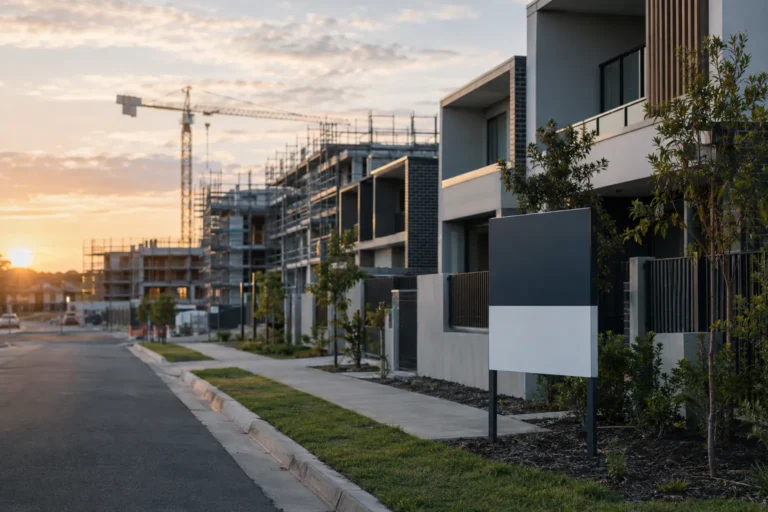
Six months after the Federal Budget promised to ease housing pressure, the evidence that buyers and builders are responding is starting to pile up. Home loan commitments are lower, investor lending has dropped sharply, and new-home sales are weaker. The policy aim was more supply and better affordability. The early data points to less investment without the extra homes arriving yet.
That is a reading of direction, not proof of cause. Interest rates, borrowing capacity and construction costs have all been moving at the same time. But a six-month window of lending, commencements and sales is a better test than any single quarterly print.
What changed and what didn’t
What changed is the behaviour of the people who fund new housing. Investors, who typically account for a large share of demand for new dwellings, appear to be stepping back. Owner-occupier commitments have also eased.
What didn’t change is the underlying shortage. Australia still needs far more homes than it is building, and population growth has not stopped. Weaker demand does not shrink that gap. It can widen it, because fewer sales mean fewer projects reach the finance and start stage.
Why a fall in investor lending matters for supply
New apartments and townhouses are usually pre-sold before a developer can secure construction finance. Lenders want to see a share of sales locked in first. If investors hold off, pre-sales stall, and projects that looked viable a year ago stop stacking up.
This is the mechanism worth watching. Investor demand is not only about speculation. In many projects it is the demand that gets the building funded. Remove it without replacing it with owner-occupier or social housing demand, and commencements follow sales down.
Key numbers
- Home loan commitments: lower over the six months since the Budget
- Investor lending: down sharply, per the latest lending data
- New-home sales: weaker, a leading signal for commencements
- Rental vacancy: still tight across most capitals
The rental squeeze is the second-order effect
When investors leave and new supply slows, renters feel it. Fewer investor-owned dwellings entering the rental pool means less competition for tenants’ business and fewer options. Where vacancy is already low, that tends to keep rents elevated for longer than renters would hope.
There is also a second layer. Some existing landlords weigh up selling when the economics of holding get worse. Each sale to an owner-occupier removes a rental. Whether that outweighs new supply is a question for the next few quarters of data, not a conclusion to draw today.
Not every softer number is a policy verdict
Here’s the catch. Lending can fall for reasons that have little to do with Budget settings. Higher rates reduce how much people can borrow. Tighter serviceability tests do the same. Our recent look at the interest rate peak and a weaker jobs market covers how those pressures interact with buyer confidence.
Capital rules matter too. Lenders facing higher capital costs ration credit, and that shows up in investor and development finance first. For more on that channel, see the capital overlay and its effect on lending capacity.
So the fair framing is this: policy may be one of several forces cooling investment, and the supply response is the part that has not shown up.
Land and approvals still set the pace
Even if demand recovers, homes need sites, approvals and trades. Where land is short, builders respond by cutting lot size rather than lifting volume, as we covered in the Geelong land shortage. Policy that lifts demand without easing those constraints tends to push prices, not construction.
That is why commencements are the number to watch. Sales and lending are sentiment. Commencements are actual shovels in the ground.
Scenarios from here
- Base case: lending stays soft for several more months while rates hold, commencements drift lower, and rental pressure persists.
- Upside: easing rates and clearer rules bring investors back, pre-sales recover, and projects restart with a lag of two to four quarters.
- Downside: weak sales feed through to cancelled projects, and the supply shortfall deepens into the following years.
None of these is a forecast. They are ranges that depend on rates, credit rules and construction costs.
One thing to check
The next time a policy is described as helping affordability, ask what happens to commencements and new-home sales in the following two quarters. If those fall, demand-side relief is not turning into homes. For broader context on funding and borrowing, our home loans, lenders and refinancing guide is a useful starting point, and you can subscribe to the newsletter for the weekly signal.
General info, not financial advice.