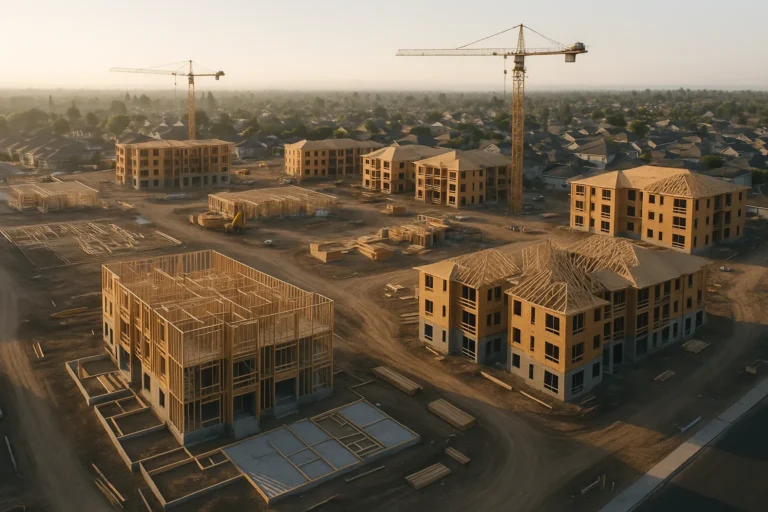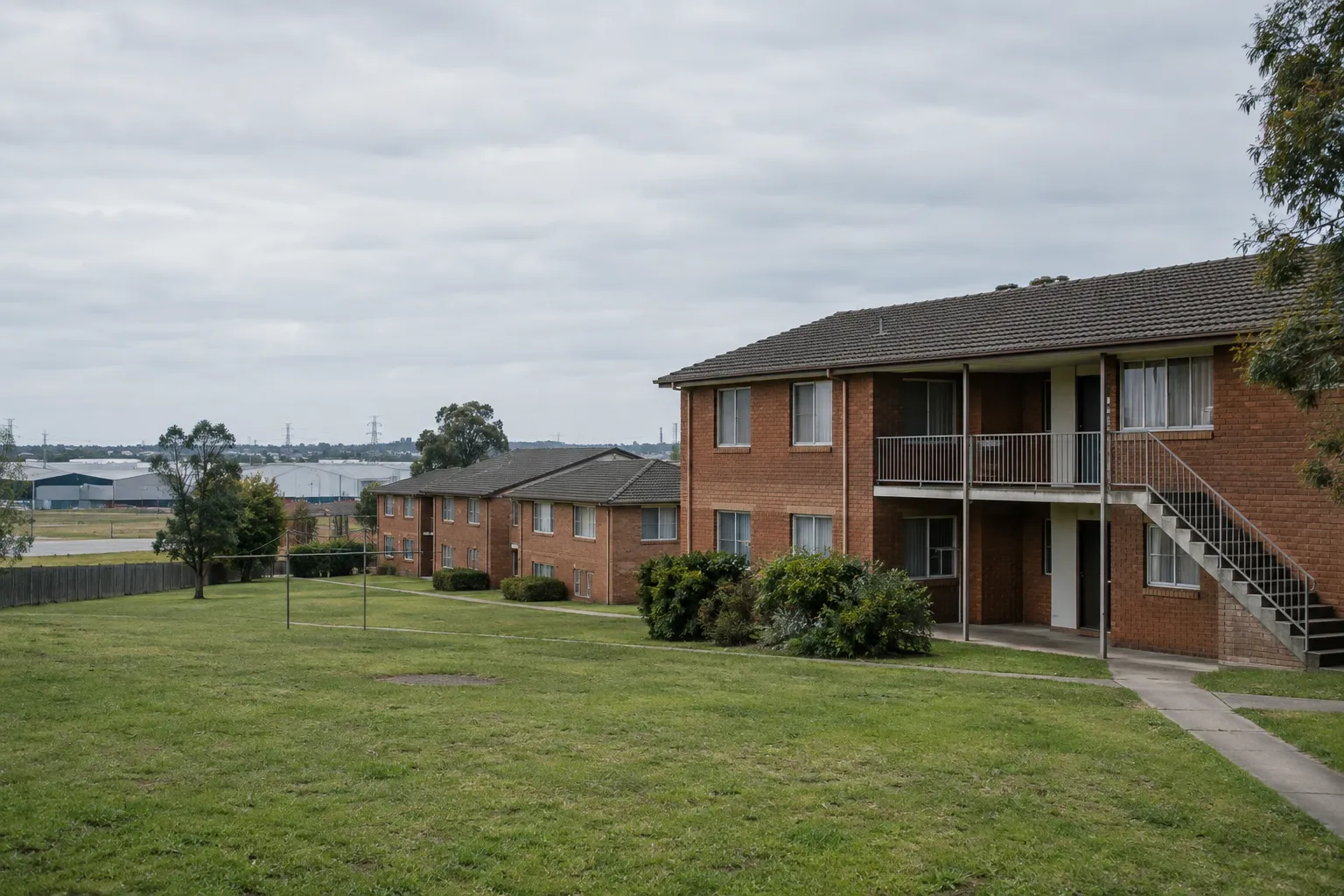
The social housing shortage Australia faces is now quantified: 510,000 additional homes required by 2050, equivalent to 23,000 completions a year. Current construction sits at roughly 3,000 homes annually, an 87 per cent shortfall that pushes vulnerable households into a private rental market already under strain.
Waitlists have climbed to 190,000 households, up 70 per cent since 2018, counting only those assessed as most in need. The pipeline lag compounds the problem: securing funding to finishing a home takes three to five years, so inconsistent funding decisions create multi-year gaps in supply.
The build rate required versus what’s delivered
New economic modelling commissioned by a peak community housing body calculates Australia needs to return to 1990s delivery levels, when social and affordable housing made up 6 per cent of total stock. The current share sits at 4.1 per cent.
Government data tracked since 2018 shows:
- 2018–2022: approximately 1,625 social and affordable homes added per year
- 2022–2025: approximately 3,100 homes per year
- Target for 2025–2029: 55,000 homes (11,000 per year average)
- Required rate to meet 2050 goal: 23,000 per year
Even if the 55,000-home target is met on schedule, and the government expects a surge in completions as projects finish, the annual rate would still fall short of the 23,000 benchmark by more than half.
Where the pressure flows when social supply lags
Households that would qualify for social housing but cannot access it compete in the private rental market, often relying on Commonwealth Rent Assistance. The spillover raises vacancy pressure, particularly in outer suburbs and regional centres where social housing stock is thinnest.
The construction lag matters for investors and landlords: a household paying 50–60 per cent of income in rent is a higher arrears risk than a social tenant on income-linked rent. Rental providers in lower-cost postcodes carry more of this demand than the headline vacancy data suggests.
Apartment construction costs force luxury bias that blocks supply, the same cost structure that pushes private developers toward premium product also makes social housing unviable without sustained subsidy.
Tax settings and supply levers: what moves the dial
Recent tax reforms retained negative gearing and capital gains concessions for new builds while removing them for established stock. Independent analysis from a think-tank found the changes would have minimal impact on total housing supply, though they may shift investment flows at the margin between owner-occupiers and investors.
The larger constraint sits at state and local planning level: zoning rules, approval timelines, and land release schedules control where new housing, social or private, can be built. Expanding social housing stock requires either:
- Direct funding (grants, low-cost debt, land transfers) that covers the gap between construction cost and what income-linked rents can service
- Inclusionary zoning mandates that require a social housing component in larger developments, shifting cost to the developer and land value
- Permanent national funding pipeline beyond the current 2029 target horizon, reducing the stop-start cycle that delays projects
The current model, a fixed-term fund delivering 30,000 homes by 2029, creates a national platform but no mechanism to continue beyond that date.
Risks and trade-offs
Base case: Commonwealth and state governments meet the 55,000-home target by 2030, but annual delivery post-2030 reverts to recent historical levels (3,000–5,000 homes per year) without a new funding commitment. Waitlists continue to grow, and the 510,000 shortfall widens.
Downside: Construction sector constraints, labour shortages, insolvencies, material cost volatility, delay completions beyond 2029. Construction labour shortage Australia: 141,000 workers short as unemployment rises already tracks a skills gap that affects both private and social builds.
Upside: State governments commit permanent co-funding and accelerate planning approvals for social housing sites. Annual delivery reaches 15,000–18,000 homes by the early 2030s, narrowing but not closing the gap.
Key unknown: Will the next federal budget beyond 2029 extend the funding pipeline, or treat social housing as a one-off intervention?
In plain English
- 510,000 homes needed by 2050 = 23,000 per year
- Current build rate = ~3,000 per year
- Government target 2025–2029 = 55,000 homes (11,000 per year)
- Shortfall even if target is met = 12,000 homes per year
- Waitlist households now = 190,000, up 70% since 2018
What it means for rental markets and investors
The shortfall flows into vacancy rates and tenant quality in lower-rent segments. Investors who assume vacancy will tighten across all price brackets miss this: social housing undersupply concentrates demand in the bottom quartile, where arrears and turnover risk is highest.
If you own in outer suburbs or regional centres, the rental pool includes a higher share of households that would be in social housing in a better-supplied system. That cohort is income-sensitive and vulnerable to rate or job shocks.
The policy question for the market: does social housing supply become permanent and funded, or does it remain a stop-start program that shifts risk back to private landlords every few years?
What to watch through 2026
- Completion volumes for social housing projects funded in 2022–2023, if the lag plays out as forecast, a spike should appear in 2026–2027 data
- State budget commitments for co-funding beyond the Commonwealth’s 2029 horizon
- Vacancy and rental growth in outer suburbs where social housing stock is thinnest and spillover demand is strongest
- Federal budget May 2025 and whether it extends or terminates the social housing funding model post-2029
For rental providers, the risk is not that social housing supply surges and competes for tenants, it’s that it doesn’t, and the bottom end of the private market absorbs demand it isn’t designed to carry.
Subscribe to the newsletter for monthly updates on housing policy, supply constraints, and what they mean for market decisions.
General info, not financial advice.