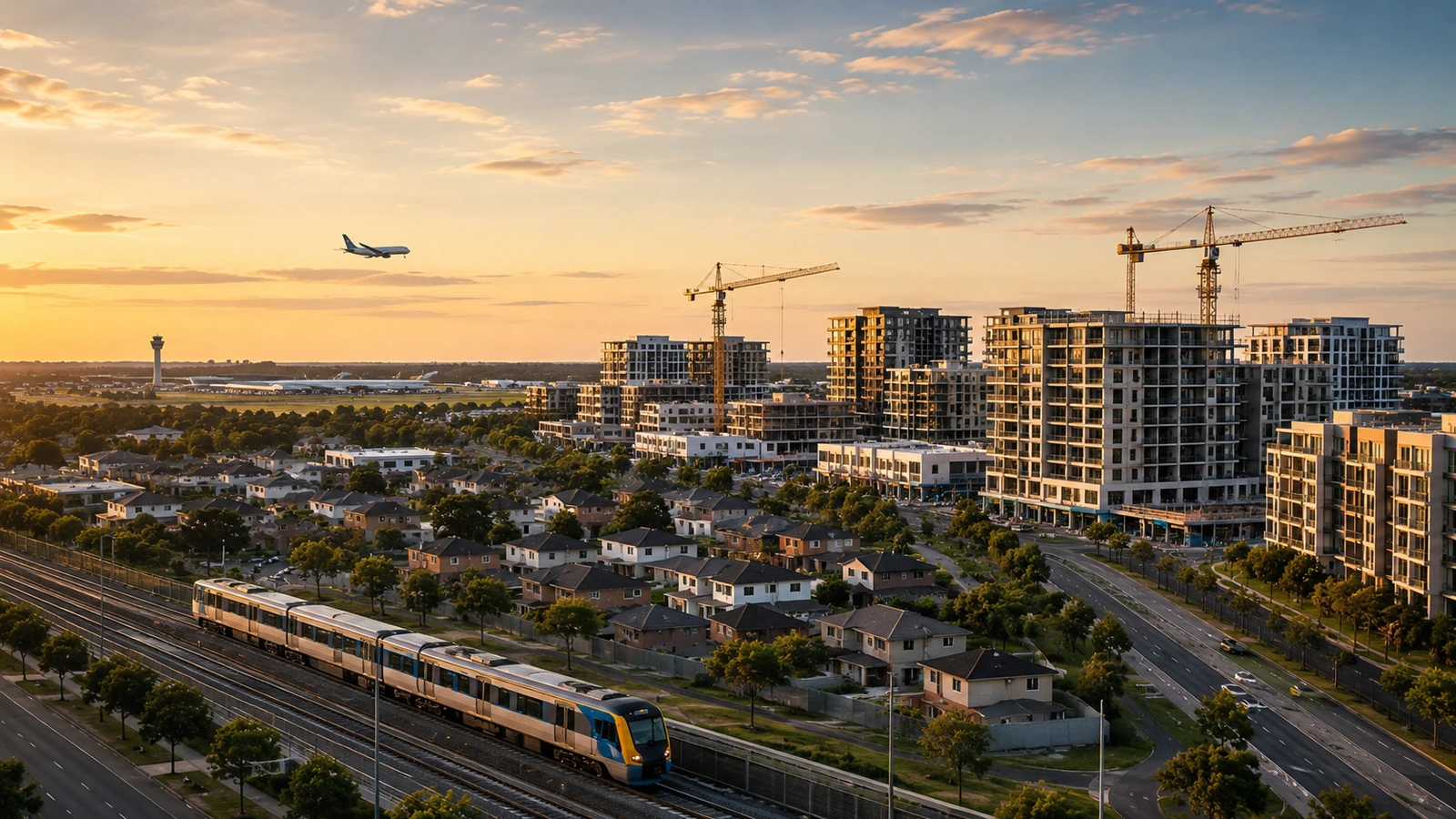
Property growth corridors are back in the investor conversation, but the old playbook looks weaker than it did two years ago.
The easy version says to follow population growth, new infrastructure and government spending. That is still useful. It is just not enough.
A corridor can have cranes, roads, rail maps and glossy masterplans, yet still disappoint if buyers overpay, rents lag, borrowing power tightens or supply lands in the wrong place at the wrong time.
The better question for 2027 is sharper: where are the growth drivers fixed enough to matter, but not so fully priced that the upside has already been spent?
Three markets deserve a closer look: Western Sydney, Melbourne’s outer west and Adelaide’s northern defence belt. None is a guaranteed winner. Each has a cleaner story than the national average.
The national average is hiding the real market
Australia’s housing market is no longer moving as one clean cycle.
Some cities have already had large price runs. Others are still carrying the weight of weaker confidence, stretched affordability or slower investor demand. That split matters because a national price index can make the market look calmer than it feels on the ground.
For investors, this is where “Australia’s property market” becomes too broad to be useful.
A suburb near a new airport, a defence precinct or a fast-growing outer corridor may behave very differently from an inner-ring market where borrowing capacity is already stretched. The same interest rate can hit both markets, but the local demand story will not be the same.
Australian Property Review has already covered why Western Sydney buyers are still fighting for every home in parts of the market where relative affordability still matters. The same logic now applies to other growth corridors: demand follows the maths before it follows the marketing.
Western Sydney now has a date, but not a free pass
Western Sydney International Airport is no longer just a long-range promise. The federal government says freight flights will start on 27 July 2026 and passenger flights on 25 October 2026. The airport itself also states it is opening on 25 October 2026.
That matters because property markets respond differently when a project moves from concept to countdown.
A fixed airport opening can support jobs, logistics demand, visitor traffic and business confidence across the broader Western Sydney Aerotropolis. It can also change how buyers think about places that were once considered too far from the centre of Sydney.
But here’s the catch: transport timing matters.
The Sydney Metro line to the airport was expected to open with the airport, but recent reporting says the rail link could be delayed until 2028.
That does not kill the Western Sydney case. It does change the sequencing.
If the airport opens before the supporting rail connection, nearby suburbs may get the long-term confidence boost before they get the full daily transport benefit. That gap can matter for renters, workers and owner-occupiers.
Quick take
Western Sydney’s appeal is not that every suburb will rise. It is that the catalyst is becoming real. Investors still need to check transport access, land supply, vacancy risk and whether the price already assumes the good news.
Melbourne’s outer west is the affordability test
Melbourne has looked weak compared with Perth, Brisbane and Adelaide, but that headline can mislead investors.
The outer west is not the same market as inner Melbourne. It is more sensitive to affordability, migration, family formation and the ability of new estates to deliver usable housing at prices buyers can still finance.
Melton and Wyndham remain important because they sit at the intersection of population growth and relative affordability. In plain English, buyers who cannot make the numbers work closer to the city often keep moving west until the deposit and repayments fit.
That does not mean the corridor is risk-free.
Outer growth markets can be exposed to land release cycles, infrastructure delays and a sameness problem. If too much similar stock hits the market at once, rents and resale demand can soften. Buyers also need to check school access, commute times, local jobs and whether the suburb is getting services at the same pace as housing.
This is where new-build policy could matter.
Australian Property Review has covered how the negative gearing shake-up is pushing investors into new apartments. If tax settings keep favouring new dwellings, investors may look harder at growth corridors. That could help projects get funded, but it may also put investors into the same price bands as first-home buyers.
The practical test is simple: do not buy the tax treatment. Buy the demand.
A new townhouse or house-and-land package still needs a tenant, a realistic rent, a cashflow buffer and a resale market that is not dependent on the next wave of grants or incentives.
Adelaide’s north has a jobs story, not just a price story
Adelaide’s northern suburbs are being watched for a different reason.
The AUKUS submarine program is turning Osborne into one of the country’s most important long-term industrial precincts. The federal government announced a $3.9 billion down payment for the new submarine construction yard in Osborne, while Defence SA says the broader yard is expected to require about $30 billion over coming decades.
That is not a normal property stimulus.
It is tied to defence, skills, construction, manufacturing and a multi-decade workforce pipeline. The property angle is not just “government spending lifts prices”. It is whether job creation and higher local incomes can support sustained housing demand across nearby suburbs.
Adelaide also starts from a different affordability base than Sydney and Melbourne. That can attract investors looking for lower entry prices and stronger yields.
Now, the part most people miss: affordability can disappear quickly when a market becomes fashionable.
Adelaide has already had a strong run. Northern suburbs near Osborne may still have a long-term demand story, but investors need to pressure-test the numbers against higher borrowing costs, insurance, maintenance and tenant depth.
A defence precinct may support employment. It does not remove vacancy risk.
Why South East Queensland needs a colder eye
South East Queensland remains one of the strongest long-term housing stories in the country.
Population growth, lifestyle migration, infrastructure spending and the 2032 Olympic Games all support the broad case. The problem is entry price.
When a market becomes the consensus trade, the margin for error shrinks. Investors can still make good decisions in popular markets, but they need stronger evidence. A good story is not the same as a good buy.
The Olympics are still years away. Between now and 2032, investors will move through multiple rate cycles, policy changes, construction delays and rental market shifts.
That does not mean avoid South East Queensland. It means treat the Olympic story as one input, not the full investment thesis.
If yields are compressed, repayments are tight and the suburb needs perfect conditions to justify the price, the risk is already showing.
The policy shift investors cannot ignore
The 2026 policy debate has added another filter to the growth corridor question.
If negative gearing and capital gains tax settings continue to favour new housing over established homes, investor demand may be pushed towards newly built dwellings. Australian Property Review has covered the risk that new-build tax incentives may hit first-home buyers if both groups are competing for the same stock.
That is the second-order effect.
A policy designed to support supply could also crowd more buyers into outer-suburban projects, lower-priced apartments and growth-area townhouses. In some corridors, that may help construction. In others, it may lift competition before enough new supply is actually completed.
For investors, the rule of thumb is this: policy can improve the after-tax result, but it cannot fix a weak asset.
The asset still needs demand, scarcity, liveability and a price that leaves room for error.
What could derail the growth corridor story
There are four risks investors should keep close.
First, infrastructure can be delayed. Western Sydney shows why that matters. The airport opening has a date, but the rail link may not arrive at the same time.
Second, supply can overshoot local demand. This is a common risk in outer growth markets where many projects are built for the same buyer and tenant profile.
Third, borrowing power can tighten without another headline rate shock. Australian Property Review has explained how APRA debt-to-income limits could affect borrowers , because credit rules can bite even when buyers feel confident.
Fourth, cashflow can turn a good long-term story into a bad holding experience. Investors using equity or stretching their serviceability should revisit the risks in using home equity to invest. Equity gives access to capital. It does not remove repayment risk.
The practical take
Property growth corridors are worth watching in 2027, but the best opportunities are unlikely to be found by chasing the loudest suburb list.
Start with three questions.
Does the corridor have a real driver, such as jobs, transport, population growth or supply constraints?
Is the timing clear enough to matter within your holding period?
Does the property still work if rent growth is slower, rates stay higher and resale demand takes longer to arrive?
Western Sydney has a fixed airport catalyst, but transport timing is a live issue. Melbourne’s outer west has affordability and population logic, but infrastructure and supply need close checking. Adelaide’s north has a serious employment story through Osborne, but investors should not ignore how far prices have already moved.
The next step is not to pick a “hotspot”. It is to build a shortlist, compare rents against total holding costs, check future supply and keep a cashflow buffer large enough to survive a dull year.
For weekly property signals without the noise, subscribe to the free Australian Property Review newsletter
General info, not financial advice.