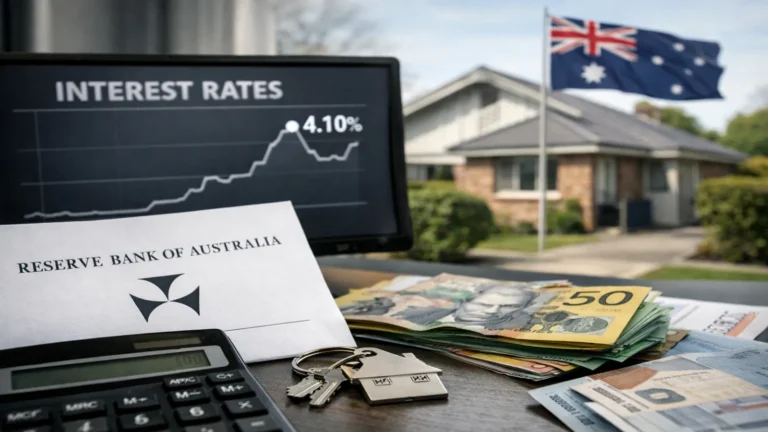
The Reserve Bank of Australia has left the cash rate unchanged at 4.35 per cent, giving mortgage holders a pause after three rate rises in 2026.
But this was not an all-clear.
The RBA said inflation remained too high and made it clear that holding rates did not rule out another increase. For borrowers, buyers and property investors, the practical message is uncomfortable: repayments may not rise this month, but the pressure has not passed.
The decision was unanimous. The Board did not consider increasing rates at the June meeting, according to governor Michele Bullock.
That sounds reassuring until you look at what the RBA is still worried about.
A pause after three increases, not the end of the cycle
The RBA lifted the cash rate three times during the first five months of 2026, taking it to 4.35 per cent in May.
At its 16 June meeting, the Board chose to wait and assess how those increases were flowing through household spending, employment and the housing market.
The official statement pointed to early signs of cooling. Consumer spending growth has slowed, unemployment has increased and housing prices are falling in some capital cities.
Those conditions gave the RBA room to hold.
What did not change was the inflation problem. The central bank said headline inflation and underlying inflation, which strips out some volatile price movements, were still too high.
The Board is particularly concerned that businesses facing higher costs may pass those costs on to customers. That is how a temporary price shock can become a broader inflation problem.
So what does that mean in plain English?
The RBA is waiting to see whether the three rate increases already delivered will do enough. It is not yet convinced they will.
Quick take
The RBA has paused because the economy is slowing, not because inflation has been defeated. Borrowers should treat 4.35 per cent as the current rate, not necessarily the peak.
Why mortgage holders received little real relief
A rate hold prevents an immediate increase in variable mortgage repayments. It does not reverse the increases borrowers have already absorbed.
Consider an owner-occupier with a $745,000 principal-and-interest mortgage over 30 years.
At a mortgage rate near 6 per cent, repayments are roughly $4,470 a month. A further 0.25 percentage-point increase would add about $120 a month, depending on the lender, loan term and repayment structure.
That additional amount may not look dramatic in isolation. The problem is accumulation.
Households are already paying more for insurance, council rates, energy, groceries and maintenance. Another $120 can be the cost that turns a modest monthly surplus into no surplus at all.
Australian Property Review previously examined the practical steps borrowers can take in Rate Pain Is Back, and Borrowers Are Running Out of Easy Moves.
The useful starting point is not predicting the next RBA meeting. It is knowing what another increase would do to your own budget.
The economy is slowing, but not clearly enough
The RBA’s decision sits between two conflicting signals.
Inflation remains above where the central bank wants it. At the same time, higher interest rates are starting to weaken economic momentum.
According to the Australian Bureau of Statistics, Australia’s economy grew by just 0.3 per cent in the March quarter, down from 0.9 per cent in the December quarter of 2025.
Household spending increased by 0.5 per cent, but the detail was weak. Spending on essentials rose by 0.8 per cent, while discretionary spending increased by only 0.1 per cent.
Households also saved less. The household saving-to-income ratio fell from 7 per cent to 6.2 per cent.
That suggests some Australians are maintaining essential spending by putting less money aside, rather than because their financial position has improved.
The unemployment rate has also risen to 4.5 per cent. Australian Property Review explored why that matters for rates and housing in Jobs Shock Puts the RBA’s Next Rate Hike on Thin Ice.
Here’s the catch.
A softer economy gives the RBA a reason to wait, but it does not automatically give it a reason to cut. Inflation would need to ease convincingly, without wage and business-cost pressures spreading further.
What the hold means for property buyers
For buyers, the decision preserves the current borrowing environment. It does not improve it.
Banks assess borrowers using a serviceability buffer above the actual mortgage rate. That means applicants must show they could manage repayments at a substantially higher assessment rate.
When market rates rise, the amount a household can borrow usually falls, even if its income has not changed.
This has three effects.
First, buyers have less bidding power. A household that could previously compete for a $1 million property may need to lower its limit or contribute a larger deposit.
Second, confidence weakens. Buyers may still attend inspections, but they become more cautious about stretching at auction or making an unconditional offer.
Third, the market becomes more divided. Affordable areas with limited listings and strong population demand may remain competitive, while expensive, highly leveraged markets can lose momentum faster.
The RBA itself noted that housing-market momentum had shifted and prices were falling in some capitals.
That does not point automatically to a national property downturn. Supply remains constrained in many markets, vacancy rates are tight and demand conditions differ sharply by city and price bracket.
But it does mean sellers can no longer assume every market will absorb weaker borrowing capacity without resistance.
Investors face a cashflow test before a price test
Property investors are often encouraged to focus on capital growth when rates are uncertain.
The more immediate issue is cashflow.
Higher mortgage costs are arriving alongside rising insurance premiums, strata levies, repairs, land tax and property-management expenses. Rent increases can offset some of the pressure, but not every investor can raise rents quickly or without increasing vacancy risk.
An investor with a thin buffer may therefore feel the rate cycle well before the property’s value changes materially.
Now, the part most people miss: higher rates can weaken the market without causing widespread forced sales.
Fewer buyers may qualify for finance. Investors may demand higher rental yields. Developers may delay marginal projects. Homeowners may postpone upgrading because the gap between their existing loan and a new one has become too expensive.
Those second-order effects can reduce transactions and price momentum gradually.
Australian Property Review examined the broader risk in The RBA’s Inflation Trap Could Hit Property Harder Next.
Three possible paths from here
The next move will depend on how inflation, employment and spending develop over the coming months.
Base case: rates stay high for longer
The RBA holds at 4.35 per cent while waiting for clearer evidence that inflation is easing.
This would give borrowers repayment stability but little meaningful relief. Housing activity could continue cooling unevenly, with stronger affordable markets outperforming more rate-sensitive areas.
Higher-rate case: inflation stays stubborn
Businesses continue passing on higher energy, transport, wage or supply costs, keeping underlying inflation elevated.
The RBA responds with another 0.25 percentage-point increase. Borrowing capacity falls further, variable repayments rise and highly leveraged households come under more pressure.
Softer-economy case: unemployment rises faster
Consumer spending weakens sharply, employment conditions deteriorate and inflation expectations remain contained.
That could remove the case for another rise and eventually reopen the discussion about cuts. But borrowers should not confuse a weaker economy with an immediately positive property outlook. Rising unemployment can weaken buyer confidence and increase repayment stress even when the rate outlook improves.
The practical move before the next meeting
If you are thinking, “okay, but what should I do?”, start with a simple pressure test.
Calculate your position under three mortgage rates:
- Your current rate.
- Your current rate plus 0.25 percentage points.
- Your current rate plus 0.50 percentage points.
Then check how much monthly surplus remains after housing costs and essential bills.
Owner-occupiers should also compare their current loan with competing rates and review whether spare cash is working effectively in an offset account.
Investors should test cashflow using realistic assumptions for insurance, maintenance, strata, land tax, management fees and at least a short vacancy period.
Buyers should ask their broker or lender to update their borrowing capacity before bidding. A pre-approval based on older rates or income information may give a false sense of certainty.
The June hold has bought households time. The sensible move is to use it.
Start here: pressure-test your repayments against one more rate increase before making your next property or refinancing decision.
For independent analysis of Australian rates, housing and property policy, subscribe to the free Australian Property Review newsletter.
General info, not financial advice.