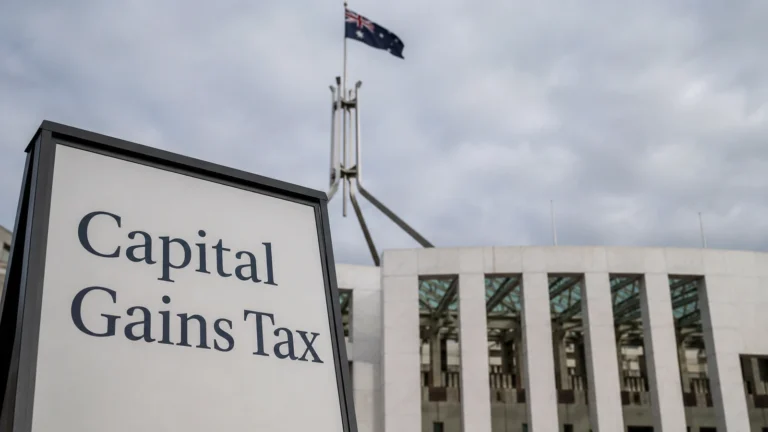
The proposed CGT changes for property investors have created an uncomfortable question for Australians relying on an investment property to help fund retirement.
Sell before the new system begins, potentially into a weakening market, or hold the property and accept that future gains may receive less generous tax treatment.
That is the tension. But claims that older investors will automatically lose hundreds of thousands of dollars need to be treated carefully.
The final result will depend on the property’s purchase price, holding period, inflation, future capital growth, the owner’s taxable income and the transitional rules ultimately passed by Parliament.
There is also a more immediate point. The federal government has proposed these changes, but the legislation remains politically contested. Investors are making decisions around a policy that could still be amended before its planned start date.
The retirement calculation has changed
Under the current system, eligible individuals who sell an asset held for more than 12 months can generally reduce the taxable capital gain by 50 per cent.
The government’s proposal would replace that discount with inflation-based cost-base indexation from 1 July 2027. A minimum tax rate would also apply to affected capital gains.
In plain English, indexation increases the original cost of an asset to account for inflation. The taxable gain is then calculated using that adjusted cost rather than the amount originally paid.
That may sound generous because investors would not be taxed on the inflation component of their return. The catch is that it may produce a worse result than the existing 50 per cent discount when an asset has recorded strong growth above inflation.
For someone holding an investment property as a retirement asset, that difference matters.
A household might have a modest superannuation balance but substantial equity in a rental property bought 15 or 20 years ago. Selling that property may be central to paying off debt, funding retirement income or moving into a more suitable home.
A higher effective tax bill reduces the amount left after settlement.
In plain English
The reform does not place a new tax on the property’s entire sale price. It changes how the taxable capital gain may be calculated. The result depends on the investor’s cost base, inflation adjustment, ownership period and personal tax position.
Australian Property Review has previously examined another overlooked part of the reform in CGT Changes Could Sting Property Investors. One concern is that a gain built over many years may still be included in taxable income in a single financial year, potentially pushing the seller into a higher tax bracket.
Existing investors are not losing every concession
The negative-gearing change has also added to the uncertainty, but the details matter.
The government proposes limiting negative gearing to newly built residential properties from 1 July 2027. However, existing arrangements are intended to remain available for properties held before the Budget announcement on 12 May 2026.
That means an older investor does not automatically lose the ability to claim eligible rental losses on a property already owned before the cut-off.
The bigger market issue is what happens to the next buyer.
An investor purchasing an established property after the Budget announcement may not receive the same ability to offset rental losses against salary or other non-property income once the new regime begins.
That could make established investment properties less attractive to some leveraged buyers, particularly when rental income does not cover interest and other ownership costs.
Australian Property Review explored that second-order effect in Negative Gearing Budget Hit May Squeeze Rents.
The practical risk for a retiring seller is not necessarily the loss of their own negative-gearing treatment. It is the possibility that the future buyer pool becomes smaller or more price-sensitive.
A weaker buyer pool could matter more than the tax bill
Property prices are set at the margin. A market does not need every investor to leave before conditions change. It only needs enough buyers to hesitate, reduce their offers or redirect their money elsewhere.
Investors who still want access to negative gearing may favour newly constructed homes. Others may shift towards shares, superannuation or assets with stronger cashflow.
That could reduce competition for some established apartments, townhouses and houses traditionally purchased by investors.
This is particularly relevant in locations where owner-occupier demand is limited or where rental yield, rather than lifestyle appeal, has been the main reason to buy.
At the same time, Sydney and Melbourne are already dealing with higher borrowing costs, stretched affordability and softer buyer confidence. Commonwealth Bank has forecast 2026 price falls of about 6 per cent in Sydney and 7 per cent in Melbourne, while expecting stronger results in Brisbane and Perth.
Forecasts are not guarantees. They are scenarios built on assumptions about interest rates, employment, confidence and credit availability.
Still, they underline the timing risk.
An investor selling before July 2027 could preserve access to the current CGT framework but receive a weaker sale price. Waiting could allow market conditions to recover, while exposing more of the future gain to the proposed system.
Neither option is automatically better.
The rush-to-sell argument has a hole in it
Predictions of a wave of investor selling assume owners will accept any price to get ahead of the tax change.
That may happen in some cases, especially where retirement timing is fixed or cashflow pressure is severe. But selling itself creates costs.
An owner may face CGT under the existing system, agent fees, legal expenses, loan discharge costs and the loss of rental income. The proceeds must then be invested somewhere else, potentially in an equally uncertain market.
A tax change can also discourage selling rather than accelerate it. Investors may decide the after-tax proceeds are too low and keep the property longer.
Australian Property Review covered this lock-in risk in Budget Tax Shock Hits Property, Shares and Trusts.
Now, the part most people miss: a property that remains profitable after tax can still be difficult to hold.
Older investors may face rising insurance premiums, maintenance, strata levies, land tax and interest costs. A property with substantial equity can still produce weak cashflow.
For retirees, the question is therefore broader than CGT.
It is whether the asset still fits the household’s need for income, liquidity and manageable risk.
Three paths for long-term owners
Most affected investors are likely to fall into one of three groups.
Selling was already part of the retirement plan
These owners should obtain a current market appraisal and a property-specific CGT estimate under the existing and proposed systems.
The decision should not rest on a general claim that the tax will be higher. It should be based on actual purchase records, capital improvements, ownership costs and the expected selling price.
The property can be held comfortably
An investor with a strong cashflow buffer and no immediate need for the capital may have more flexibility.
Waiting could provide time for the legislation to become clearer and for local market conditions to improve. The trade-off is continued exposure to property costs, market risk and the proposed CGT rules.
The property is already causing financial strain
Tax should not become an excuse to hold an unsuitable asset.
A landlord facing persistent cashflow losses, major repairs or a weak long-term outlook may be taking more risk by waiting than by selling. The relevant comparison is the after-tax position under each option, not the size of the tax bill in isolation.
What could still change
The reform must survive the parliamentary process, and the government has already altered parts of its broader tax package following political and industry pressure.
Further concessions, transitional arrangements or technical amendments remain possible.
Property valuations will also matter. Assets held across the 1 July 2027 transition may require gains to be divided between the existing and new systems. That makes record-keeping more important, particularly for properties bought decades ago.
Investors should retain contracts, stamp-duty records, renovation invoices, legal costs, depreciation schedules and evidence of other expenses that may affect the cost base.
The market response is another unknown.
Redirecting investors towards new builds could support construction and developer finance over time. It could also concentrate investors and first-home buyers in the same lower-priced apartment projects.
For more on that pressure point, read Negative Gearing Shake-Up Hits New Apartments.
The practical move before making a decision
Do not decide whether to sell using a national forecast or a headline estimate of the possible tax loss.
Start with two written scenarios from a qualified tax adviser:
- An estimated sale before 1 July 2027 under the current CGT framework.
- An estimated sale after the proposed reforms, using reasonable inflation and price-growth assumptions.
Then compare the net proceeds with the likely cost and income of holding the property.
Pressure-test both outcomes against a weaker sale price, an unexpected repair and a longer selling period. That will tell you more than a general debate about whether property investors are winners or losers.
The policy direction is less favourable to some forms of property investment. That does not mean every older investor should rush to sell.
It means retirement plans built around one property now need better numbers.
Start here: calculate the estimated after-tax proceeds under both sale dates before changing your retirement strategy.
Get the week’s clearest property, finance and policy analysis from Australian Property Review. Subscribe to the free newsletter.
General info, not financial advice.