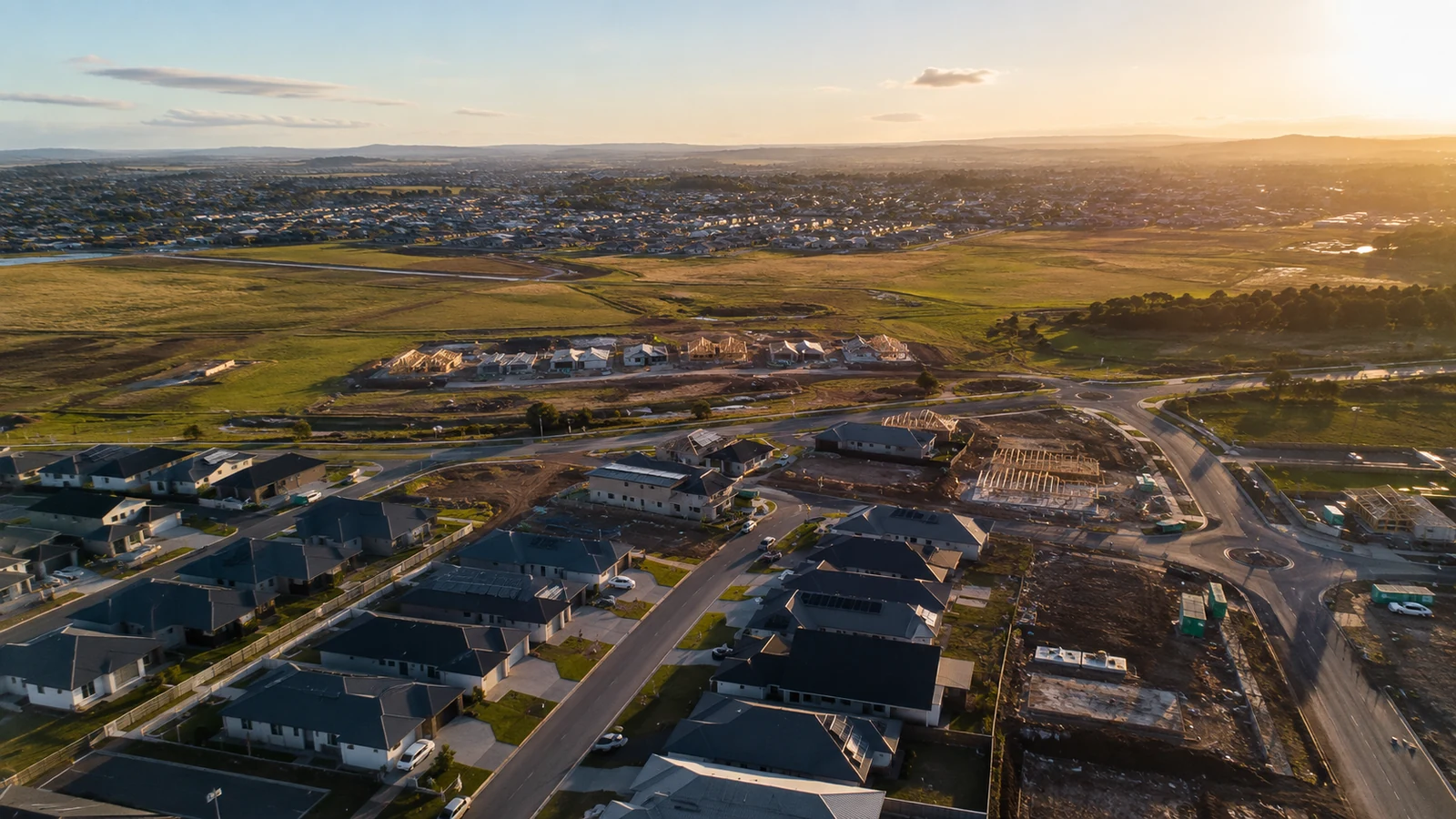
Frasers Property has made a sizeable bet on Australia’s eastern seaboard, adding about 3,800 potential homes to its residential development pipeline through acquisitions on the Gold Coast and in Geelong.
The headline number is large. The more useful signal is where the company is putting its capital and how long it expects the new housing to take.
On the Gold Coast, Frasers Property Australia has acquired freehold land and development rights connected to the 334-hectare SkyRidge community for about $170 million. The company expects to develop roughly 3,000 lots and a neighbourhood shopping centre over 14 years.
In Victoria, it has secured a 60-hectare Geelong site with planning approval for more than 720 homes. The first sales release is expected around mid-2027, with the project scheduled to unfold over about five years.
That is a meaningful addition to the Frasers Property housing pipeline. It is not, however, 3,800 completed homes entering the market today.
The developer is buying time as well as land
Both acquisitions have something developers value highly: a pathway through at least part of the planning system.
The Geelong land already has a planning permit. SkyRidge has ministerial approval covering thousands of lots across several land uses, while construction is already under way on an initial group of 203 lots.
That reduces some of the uncertainty that comes with buying raw land and then spending years trying to secure permission to develop it.
So what does that mean in plain English?
A site with planning progress can allow a developer to move towards sales and construction sooner than an equivalent parcel that still faces rezoning, assessment and community objection risks. It does not eliminate delivery risk, but it can make the project easier to assess, finance and stage.
This matters in a market where approved supply does not always become viable supply. Construction costs, infrastructure charges, labour availability, finance and buyer demand still determine whether a planned home becomes a completed one.
Australian Property Review recently examined this weak link in Australia’s projected 262,000-home housing shortfall. A national development target can look strong on paper while individual projects stall before construction.
In plain English
Frasers Property has secured the opportunity to deliver about 3,800 homes. It has not added 3,800 homes to the market yet. The supply benefit will arrive in stages and depends on costs, infrastructure, financing and sales demand continuing to stack up.
Why the Gold Coast site matters most
SkyRidge is the larger and more strategically significant acquisition.
The estate sits at Worongary in the Gold Coast hinterland and is reportedly the only major masterplanned community in the local market currently selling house lots. That gives it unusual importance in a region where detached housing supply is constrained by geography, infrastructure capacity and strong population demand.
Frasers Property plans to deliver about 3,000 lots at the estate, alongside a neighbourhood shopping centre. The first priority will be the 203 lots already under construction, which are expected to reach completion progressively from late 2026 through to mid-2027.
Here’s the catch.
The full project has a 14-year development horizon. Even if the estate progresses broadly as planned, the supply will be released gradually rather than landing as one large affordability shock.
That is normal for a masterplanned community. Roads, utilities, parks, shops and housing stages need to be sequenced. Developers also tend to release lots in line with market demand rather than flood an area with competing stock.
For buyers, this means SkyRidge may expand choice over time without necessarily causing a sudden drop in nearby land prices.
For investors, it means the local supply pipeline deserves close attention. A suburb can remain undersupplied at the regional level while individual estates create periods of intense competition between similar new properties.
Geelong offers a different kind of bet
The Geelong acquisition is smaller but has a faster proposed delivery schedule.
The site is expected to accommodate more than 720 homes, a neighbourhood activity centre, community facilities, open space and local services. Lot sizes are expected to vary, while townhouses could form part of the more affordable product mix.
Its location in Geelong’s southern growth corridor places it near established expansion areas such as Armstrong Creek, as well as transport links connecting residents with central Geelong, Melbourne and the Surf Coast.
The strategic case is straightforward. Geelong offers buyers an alternative to Melbourne, with access to regional employment, education, beaches and commuter links.
But investors should avoid treating population growth or a large development announcement as an automatic capital-growth signal.
New estates can improve amenity and attract households. They can also create years of competing land releases, house-and-land packages and near-identical resale stock.
Australian Property Review’s earlier analysis of why Geelong is attracting renewed investor attention outlined the city’s affordability and economic appeal. The new Frasers development adds another factor to pressure-test: how much supply is planned in the specific corridor where you are considering buying.
A useful rule of thumb is to examine the market below the city level. Check how many lots, townhouses and completed homes are scheduled within the same school catchment or five-kilometre radius, not just across Greater Geelong.
Asset sales are funding the next development cycle
The purchases also reveal how Frasers Property is managing its balance sheet.
Before announcing the two residential acquisitions, the company completed or progressed several major asset sales. These included Eastern Creek Quarter in Sydney for $400 million and Burwood Brickworks in Melbourne for $107.25 million.
It also handed over a Brisbane build-to-rent project valued at about $285 million.
The company says those transactions allowed it to recycle capital into the Gold Coast and Geelong opportunities.
Capital recycling means selling completed or mature assets and reinvesting the proceeds into new developments. For a large property group, it can free money from projects that have reached the end of their development phase and direct it towards sites with longer growth potential.
The second-order effect is worth watching.
When large developers direct capital towards approved residential land, it can indicate confidence in long-run housing demand. It can also reflect a preference for markets where the planning pathway and project economics appear more workable.
That does not prove Queensland or regional Victoria will outperform. It shows where one major developer believes it can deploy capital at scale.
A similar shift appeared when Meriton reportedly reduced new site buying in Sydney and focused more heavily on Queensland. Australian Property Review covered what that move could mean in Meriton’s Sydney housing-supply warning.
The number of lots is not the same as the number of homes
Large pipeline announcements often blur three separate stages:
- Land controlled by the developer
- Homes approved or planned
- Homes completed and ready to occupy
Only the third stage directly adds usable housing supply.
Between acquisition and completion, projects remain exposed to construction inflation, contractor availability, lending conditions, infrastructure delivery and changes in buyer demand.
The ownership structure at SkyRidge adds another detail.
Frasers Property has acquired development rights connected to most of the estate, but it does not own all the underlying land. Much of that land remains associated with a deceased estate managed for its beneficiaries by a court-appointed administrator.
That arrangement does not mean development cannot proceed. It does mean readers should distinguish between buying an entire estate outright and acquiring the rights to manage and deliver development across land held under a separate ownership structure.
Now, the part most people miss: control and ownership are not always the same thing in a large property project.
What could slow the rollout
The base case is that an experienced developer, existing approvals and staged construction will progressively add much-needed housing in both regions.
Several risks could still alter the timetable.
Construction and infrastructure costs could rise faster than sale prices. Higher interest rates could weaken borrowing capacity and slow presales. Labour shortages could stretch delivery periods. Governments or utilities could take longer than expected to provide roads, schools and essential services.
There is also demand risk.
A developer may control thousands of future lots, but it still needs enough buyers at viable prices to justify each new stage. If buyer demand weakens, release schedules can be extended.
The reverse is also possible. Strong household growth and limited competing stock could allow stages to sell quickly, supporting faster releases where construction capacity permits.
This is why the announced 14-year and five-year timelines should be treated as working programs, not certainties.
What buyers and investors should do with the news
Homebuyers considering the Gold Coast or Geelong now have another large supply pipeline to factor into their decisions.
That is not automatically a reason to avoid these locations. New development can bring roads, shops, parks, schools and more housing choice. These improvements can make an area more functional and attractive over time.
The practical question is whether you are paying today for benefits that may take years to arrive.
Before buying in or near either estate, compare the purchase price with established alternatives and check:
- the expected timing of nearby stages
- how many similar properties could compete for tenants or buyers
- body corporate or estate costs, where applicable
- transport and community infrastructure already operating, rather than merely proposed
- the gross and net rental yield after realistic expenses
- whether your holding position still works if completion or amenity delivery runs late
For an owner-occupier, a new home in a planned community may still make sense if the location and product fit a long-term lifestyle decision.
For an investor, the standard needs to be tougher. The property should work without relying on scarcity claims that a 3,000-lot pipeline may eventually undermine.
Bottom line
Frasers Property’s two acquisitions are a strong vote of confidence in long-term housing demand on the Gold Coast and in Geelong.
They also expose the timing problem at the centre of Australia’s housing shortage.
Developers can buy land, secure approvals and announce thousands of future homes. Buyers still need to wait for infrastructure, construction and staged releases before those numbers translate into actual keys.
The practical next step is to check the development pipeline surrounding any property you are considering, then pressure-test the price and rent against several years of competing supply.
Get the weekly signal without the property spin. Subscribe free to the Australian Property Review newsletter.
General info, not financial advice.