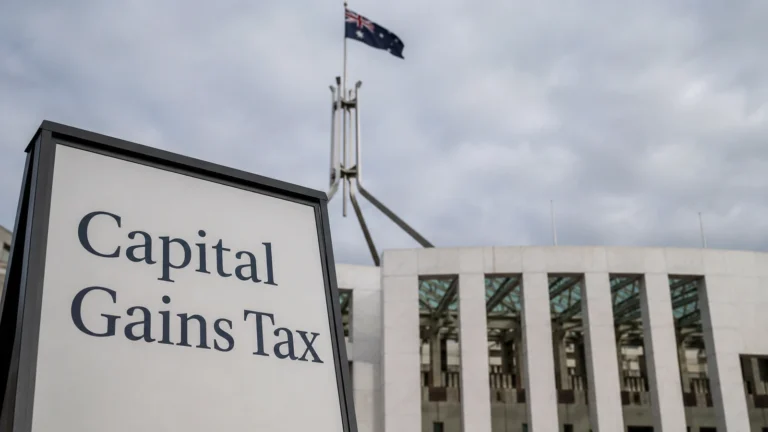
The government’s pitch is simple enough: reduce generous tax concessions, make the system fairer, and take some heat out of asset markets.
The objection from accountants, property bodies and investor groups is also clear: if the rules are rushed or poorly designed, they could make investment less attractive, increase complexity, and hit rental supply before new housing arrives.
Both sides have a point.
That is why property investors should not treat this as a political shouting match. The real issue is not whether every concession should stay forever. The real issue is timing, design and second-order effects.
A tax change can look clean on paper and still create messy behaviour in the market.
The reform is about more than tax fairness
Capital gains tax, or CGT, applies when an asset is sold for a profit. For property investors, it affects the exit decision. It changes what the owner keeps after years of debt, maintenance, vacancies, interest-rate cycles and market risk.
Negative gearing works differently. It affects the holding period. It changes annual cashflow while the investor owns the asset.
That distinction matters.
A change to negative gearing can make a property harder to hold each year. A change to CGT can make the final reward less attractive when the investor eventually sells.
Put the two together and the investment equation changes at both ends.
Australian Property Review has previously explained why CGT changes could sting property investors, especially when the tax impact arrives in one financial year. That issue becomes more important if investors are already under pressure from higher repayments, insurance, land tax and maintenance costs.
The government’s broad argument is that tax concessions have helped investors bid up prices, particularly in established housing. The counter-argument is that investors also provide rental stock, and discouraging them too quickly could make life harder for tenants.
That is the tension.
What changed and what stayed the same
The debate has sharpened because peak accounting and property groups are now openly warning about complexity and confidence.
The concern is not only the tax rate. It is the machinery around the change.
If investors, accountants and advisers cannot clearly model the after-tax return, they become more cautious. Some delay purchases. Some sell earlier than planned. Some shift capital into other assets. Some avoid structures that suddenly look too uncertain.
That does not mean every investor exits the market.
But marginal buyers matter.
The housing market is often moved by the buyer at the edge, not the average owner who does nothing. If enough marginal investors pause, rental supply can tighten even if the policy is aimed at improving affordability over time.
What has not changed is the underlying housing problem.
Australia still needs more well-located dwellings. Tax reform does not pour slabs, connect services, approve townhouses or fix builder insolvency risk. It can shift incentives, but it cannot replace planning reform, infrastructure delivery and construction capacity.
That is the part most people miss.
In plain English
The government wants to reduce tax advantages that favour investors.
Industry groups warn the changes could reduce investment and increase tax complexity.
Both can be true at the same time.
A fairer tax system may still create rental-market pressure if supply does not respond quickly enough.
The renter problem hiding inside the investor debate
For renters, the risk is timing.
If investor demand falls before new housing supply increases, the rental market can tighten. That may mean fewer listings, less choice and more pressure on rents.
This is why tax reform and supply reform cannot be treated as separate conversations.
A policy that reduces investor demand for established homes may help some first-home buyers. But if it also discourages private capital from funding new rentals, the pressure may shift from buyers to tenants.
Australian Property Review has covered this trade-off in Negative gearing changes risk a rental market squeeze. The key point is simple: reducing investor tax benefits may improve fairness, but renters could wear some of the adjustment if new homes do not arrive fast enough.
That does not mean the current system is perfect.
It means the reform has to be judged against the housing system we actually have, not the housing system we wish we had.
Australia relies heavily on private landlords to provide rental homes. Until institutional build-to-rent, community housing and public housing fill a much larger share of the market, policy that changes mum-and-dad investor behaviour can flow through to tenants.
Why accountants are worried
Accountants tend to worry less about slogans and more about implementation.
That matters here.
Tax complexity is not just an inconvenience for high-income investors. It changes behaviour. If the rules require extra valuations, new calculations, transitional tests or uncertain treatment across trusts, companies and individuals, the cost of compliance rises.
For a large investor, that may be annoying but manageable.
For a smaller landlord, it can be the difference between holding and selling.
There is also a trust issue. Not a family trust issue, although those matter too. A confidence issue.
When tax rules change with limited consultation, investors start pricing in future policy risk. That can make long-term investment less appealing because the rules of the game feel less stable.
Australian Property Review has also looked at how trust tax changes put property investors on notice. The common thread is uncertainty. Investors do not need perfect tax settings. They need settings they can understand before committing capital.
Who could win and who could lose
The possible winners are clear enough.
First-home buyers may benefit if investor demand for established properties softens. The benefit would likely be strongest in markets where investors compete directly with owner-occupiers for similar homes.
The federal budget may also benefit if fewer tax concessions are claimed over time.
The fairness argument is strongest where tax benefits mainly flow to higher-income households with more capacity to hold assets.
The possible losers are also clear.
Highly geared investors could face weaker after-tax returns. Smaller landlords may decide the risk and compliance burden are no longer worth it. Renters could face tighter conditions if investor participation falls faster than new supply arrives.
There may also be a broader investment effect.
Property is only one part of the CGT debate. Shares, small business assets, start-ups and trusts can also be caught in the same tax-policy orbit. If investors believe the reward for long-term risk has been reduced, some capital may move into safer or simpler places.
That is not always bad. Some speculative demand probably should be cooled.
But there is a line between reducing distortion and discouraging productive investment.
The policy challenge is finding that line.
The housing supply test
The cleanest test for the CGT changes is not political. It is practical.
Do the changes increase the number of homes available to live in?
If the answer is no, the affordability benefit depends mostly on shifting demand rather than increasing supply.
That can still lower prices at the margin. But demand-side relief has limits, especially when population growth, household formation and construction bottlenecks keep pressure on the system.
For property investors, the more important question is whether the rules favour new supply clearly enough.
If new builds receive better treatment, investors may move towards apartments, townhouses and house-and-land packages. That could support construction, but only if projects are viable, financeable and delivered in areas where people want to live.
Here’s the catch: a tax incentive does not fix a bad development site.
Investors still need to pressure-test vacancy risk, strata costs, build quality, local employment, transport access and resale demand. A tax concession can improve the equation, but it cannot turn a weak asset into a strong one.
What would change the outlook
The base case is more uncertainty before clarity.
Investors should expect further argument around exemptions, transition rules, trusts, small business treatment and how different asset classes are handled.
The upside case is that the government narrows the reform, gives clearer grandfathering, protects genuine new supply incentives and reduces compliance friction. That would not remove all investor concern, but it could reduce the risk of a sharp behavioural shift.
The downside case is a messy reform that is technically complex, politically bruising and poorly understood. That could encourage investors to sit on their hands, sell earlier than planned, or avoid new commitments until the rules settle.
For the housing market, the most important 4 to 12 week signs are:
- Whether the government softens the rules further.
- Whether new-build incentives become clearer.
- Whether investor lending begins to slow.
- Whether rental listings tighten in major capitals.
- Whether accountants and tax bodies keep warning about implementation risk.
None of those signals should be read alone. Together, they will show whether this is a tax debate that stays in Canberra or one that starts changing property decisions.
The practical take for investors
Do not make a rushed decision based on headlines.
Start with one question: would the investment still make sense if the tax benefit were smaller?
If the answer is no, the deal may be relying too much on policy settings and not enough on asset quality.
For existing investors, the next step is to review the exit plan. Not necessarily to sell, but to understand the after-tax position under different scenarios. That means checking holding period, unrealised gain, ownership structure, debt level and likely future cashflow.
For new investors, the filter should be stricter.
A property should stand up on fundamentals before tax treatment is added. Look at rental depth, vacancy risk, maintenance burden, insurance, strata exposure, land tax and realistic resale demand.
Tax can improve a good investment. It should not be the reason the investment works.
Bottom line
The CGT changes debate is not just about fairness, and it is not just about investor self-interest.
It is about how Australia balances three competing goals: making the tax system fairer, keeping investment flowing, and adding enough homes to ease pressure on buyers and renters.
That balance is hard.
A reform that reduces tax concessions may be defensible. A reform that does it without enough clarity, supply response or transition planning could create problems the housing market does not need.
Start here: pressure-test your property plan without assuming today’s tax settings last forever.
If you want the weekly signal on property policy, rates and investment risk, subscribe free to the Australian Property Review newsletter.