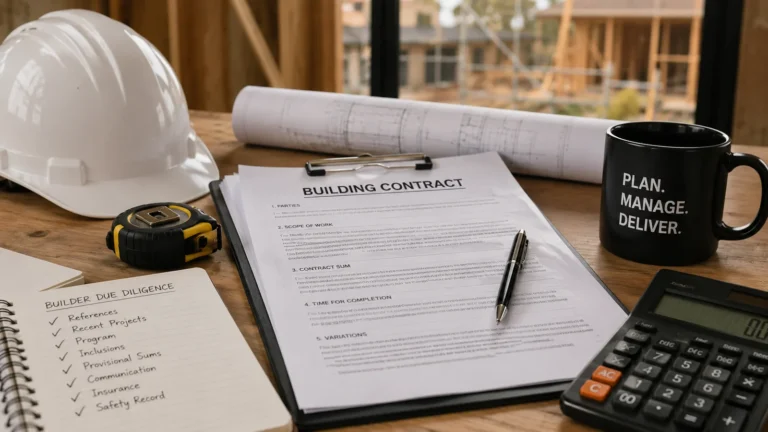
A builder can make a project look simple before the contract is signed.
The quote is sharp. The sales meeting feels smooth. The timeline sounds manageable. The photos look polished.
Then construction starts.
That is when the real builder checks matter. Not the surface-level checks. Not a quick ABN search and a scroll through Instagram. The useful checks are about proof, pressure and contract control.
For developers, renovators and investors, this is not just a construction issue. It is a capital protection issue. When building costs are already under pressure, a weak builder decision can turn a viable project into a cashflow problem.
Australian Property Review has previously covered how higher building costs can squeeze fixed-price contracts and delay projects in Why build costs could jump for new homes in Australia. That matters here because the builder you choose is often the person who controls how those pressures show up in your project.
The first test is evidence, not confidence
The wrong question is: “Can you do this job?”
Most builders will say yes.
The better question is: “Show me where you have done this exact type of job before.”
That difference matters.
A townhouse project is not the same as a single dwelling. A knockdown rebuild is not the same as a cosmetic renovation. A sloping block is not the same as a flat site. A small apartment build has different pressure points to a duplex.
The right builder checks start with comparable proof.
Ask for completed projects that match your project type, site complexity and budget range. Then go beyond the finished photos. Photos tell you what the project looked like at the end. They do not tell you what it cost, how long it took, how many disputes happened, or whether the client would use the builder again.
Speak to past clients where possible. Ask direct questions:
Did the builder finish close to the promised timeline?
Were variations explained before work changed?
Did communication improve or deteriorate under pressure?
Were defects handled properly?
Would you sign with the same builder again?
A builder does not need a perfect history. Property development is messy. What you are looking for is a pattern of delivery, communication and accountability.
Quick take: A good builder can explain what went wrong on past jobs and how they fixed it. A risky builder only wants to show you the glossy finish.
Price is only useful once the scope is clear
A cheap quote can be a genuine advantage.
It can also be a warning.
The catch is that a quote is only comparable if the scope is comparable. If one builder includes site preparation, drainage, retaining walls, finishes, approvals and realistic allowances, while another leaves half of that vague, the cheaper quote may not be cheaper at all.
This is where many projects get into trouble. The owner compares the headline number, not the exclusions.
Now, the part most people miss: omissions often become variations later. A variation is a change to the agreed work, usually with extra cost or time attached. Some variations are unavoidable. Others are just weak quoting dressed up as “unexpected” project movement.
Before choosing a builder, pressure-test the quote line by line.
What is included?
What is excluded?
Which allowances are provisional?
How long is the quote valid?
What happens if material prices move?
What work depends on engineering, council or site conditions?
This is especially important in the current supply environment. Australian Property Review has written about the pressure on the construction sector in Builders seek relief as housing costs surge. When builders are dealing with thinner margins and input cost volatility, vague contracts can become expensive very quickly.
Watch how they handle uncomfortable questions
A project rarely fails because one thing goes wrong.
It usually fails because several small issues are handled badly.
This is why communication is not a soft skill. It is a risk control.
Before signing, ask the builder what happens when the plan changes. Ask how variations are priced. Ask how delays are reported. Ask who you speak to once the job starts. Ask how often you get updates. Ask what happens if a subcontractor falls behind.
Then listen carefully.
A strong builder will answer plainly. They may not give you the answer you want, but they should give you a clear process.
A weak builder will avoid detail. They may talk around the issue, blame councils, blame clients, blame suppliers, or treat your questions like an inconvenience.
That matters because pressure exposes the operating system.
When the project is calm, most builders look organised. When materials are delayed, weather turns, trades clash or costs move, you find out who can manage a job and who was only good at selling one.
The contract is where control shifts
This is the most important part of the decision.
Once you sign, the balance of power changes.
The builder controls sequencing. The builder controls the claim process. The builder controls how quickly issues are escalated. The builder often understands the contract better than the client.
That does not mean contracts are unfair by default. It means you should not treat the contract as admin.
You need to understand:
payment stages
variation rules
delay clauses
liquidated damages, if any
defect periods
allowances and exclusions
termination rights
dispute process
insurance and licensing requirements
Do not rely on the sales conversation. The contract is what matters when there is a dispute.
This is also where investors and small developers need to think beyond construction. A delayed build can affect holding costs, loan buffers, rental start dates and resale timing. Australian Property Review has covered this timing risk before in The low-deposit land trap, where cheap entry costs can hide the larger risk of delayed income and extended holding costs.
What changed and what didn’t
What changed is the margin for error.
Higher finance costs, construction cost pressure and tighter household budgets mean a weak builder decision can bite harder than it did in a cheaper-money cycle.
What did not change is the basic rule: the cheapest builder is not always the cheapest outcome.
A builder who prices properly, communicates clearly and delivers reliably may look more expensive at the start. But if they reduce delays, disputes, defects and surprise variations, the total project result may be better.
The reverse is also true. A builder who wins the job with a thin quote may need to recover margin later, either through variations, slower delivery or lower quality.
That is not always malicious. Sometimes the builder simply priced the job badly. Either way, the risk lands with the owner.
The practical builder checks before you sign
Start with three checks.
First, ask for proof on projects that look like yours. Same dwelling type. Similar site conditions. Similar budget. Similar complexity.
Second, test the builder under pressure before the pressure arrives. Ask difficult questions about delays, variations, defects and communication. The answer matters, but the way they answer matters too.
Third, read the contract as if something will go wrong. That is not pessimism. It is basic risk management.
If you are funding the project with borrowed money, this also connects to serviceability and cashflow buffers. Australian Property Review has written about the risk of using debt to fund investment decisions in Using Home Equity to Invest: What the Numbers Miss. The same principle applies here: debt magnifies outcomes, good and bad.
Bottom line
Builder checks are not about finding a perfect operator.
They are about reducing the chance of a bad surprise after you have already handed over control.
A good builder can show relevant proof, explain how they manage pressure and walk you through the contract without hiding behind vague language.
A risky builder leans on price, polish and promises.
If you are about to sign, slow the decision down. Compare scope, check references, read the contract and make sure your cashflow buffer can survive delays or variations.
Start here: before your next builder meeting, write down the three questions you least want to ask. Then ask them anyway.
Want the weekly property signal without the spin?Subscribe to the free Australian Property Review newsletter
General info, not financial advice.