Margins are tighter, costs move faster, and one weak adviser can turn a good site into a slow bleed.
Property development is not just about finding a block, drawing townhouses and hoping the resale market does the heavy lifting.
That was never a strong strategy. Now it is even more exposed.
Higher holding costs, stretched builders, cautious lenders and planning complexity mean small mistakes can compound quickly. A site that looks profitable on a spreadsheet can lose its edge through delays, redesigns, build-cost creep or an overconfident end-value estimate.
The opportunity has not disappeared. Australia still needs more well-located housing, especially medium-density homes close to transport, jobs, schools and services. But the bar has lifted.
The developers who survive this part of the cycle are not necessarily the boldest. They are usually the ones who pressure-test the numbers early, keep the design buildable, and surround themselves with people who can spot problems before they become expensive.
The mistake is thinking the site does all the work
A development site is only the starting point.
The real question is whether the site can become a finished product at a cost, timeframe and resale price that still makes sense after tax, finance, consultant fees, contingency and selling costs.
That sounds basic. It is where many first-time developers get caught.
They fall in love with the land, then work backwards to justify the deal. A sharper approach starts with the finished product. What can actually be built? Who will buy it? What will they pay? What will it cost to deliver? How long will council, finance and construction take?
If those answers are vague, the site is not cheap. It is unclear.
Australian Property Review has covered this same pressure in the broader supply pipeline. Approvals can rise, but housing still fails to reach the market if projects do not stack up financially. Read more: Dwelling approvals rise, but supply risks remain.
Start with the numbers, then challenge them
A feasibility study is not a confidence document. It is a stress test.
At a minimum, it should include the land purchase, stamp duty, legal costs, consultant fees, planning costs, subdivision costs, finance costs, build cost, contingency, GST, selling costs and realistic resale values.
The dangerous line item is often the one that looks too neat.
Build cost is a good example. A developer may allow a broad square-metre rate, then discover later that slope, trees, drainage, access, soil conditions, services or design complexity have changed the equation.
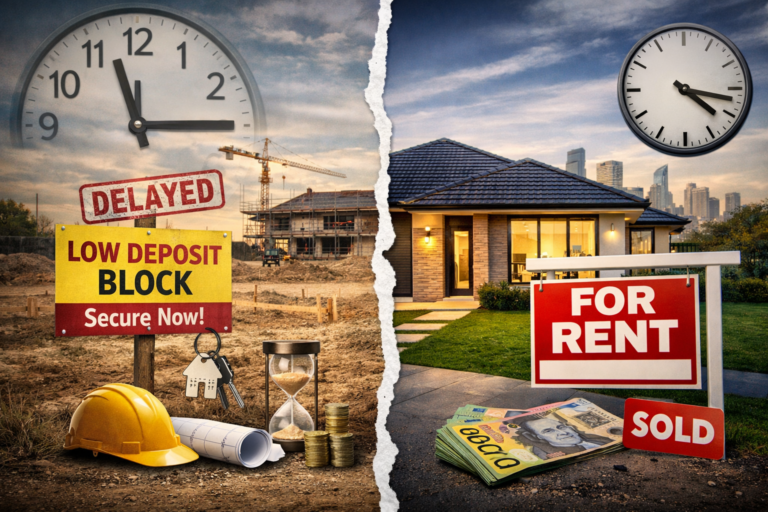
Holding costs are another quiet margin killer. A project delayed by three to six months can absorb a meaningful share of profit, especially when debt is expensive.
Here’s the catch. The spreadsheet is only as good as the assumptions behind it.
A safer feasibility should include three resale cases:
- pessimistic
- base case
- upside
It should also include a time buffer and a cost buffer. For smaller residential projects, many developers think in terms of a contingency linked to build cost, but the exact number depends on site risk, design certainty and contract structure.
The practical rule of thumb is simple: if the project only works when everything goes right, it probably does not work.
Quick take: Property development is a margin game. Your first job is not to find the biggest possible project. It is to find a project where the downside is survivable if costs rise, resale values soften or approvals take longer than expected.
The core team matters more than the pitch deck
A first-time developer does not need a huge team. They need the right people early.
The most important advisers usually include:
- a designer or draftsperson
- a town planner
- a land surveyor
- a builder
- a broker
- an accountant
- a conveyancer or solicitor
Each role protects a different part of the deal.
The draftsperson or designer helps turn the site into a product. That means room sizes, layout, parking, private open space, orientation, liveability and the type of dwelling the market will actually value.
The town planner helps assess what council and planning rules are likely to allow. That matters because the highest theoretical yield is not always the fastest, cleanest or most profitable pathway.
The land surveyor is often needed earlier than beginners expect. Boundaries, easements, title details, levels and subdivision pathways can all affect what is possible.
The builder is the person too many developers bring in too late.
That is a mistake.
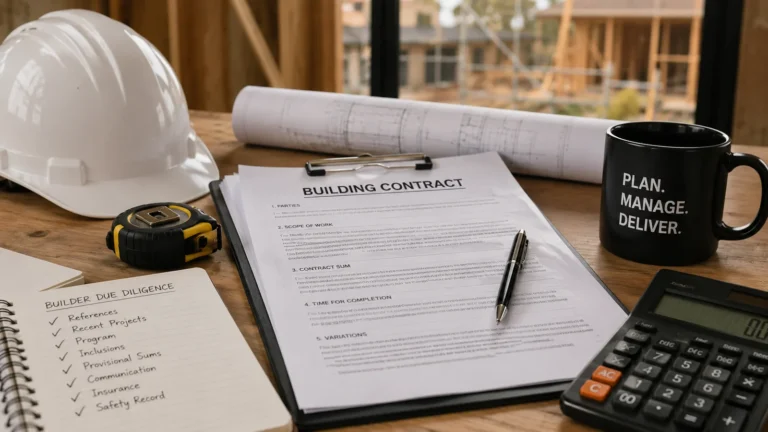
A good builder can flag whether the design is economical to construct, whether access is difficult, whether materials or labour could cause problems, and whether the assumed build cost is still realistic.
This is where the second-order effects show up. A design change made to win planning approval can create extra construction cost. A slightly larger dwelling can improve resale value but hurt build efficiency. A premium finish can help sell the product but reduce margin if buyers in that location will not pay for it.
The project is not just designed on paper. It is delivered in the real construction market.
That is why Australian Property Review’s recent coverage on building costs matters. Cost shocks, labour pressure and uncertainty can make housing projects harder to justify, even when demand exists. Read more: Builders seek relief as housing costs surge.
Planning reform helps, but it does not remove risk
Planning reform is changing the opportunity set in parts of Australia.
In Sydney, low and mid-rise reforms have opened new possibilities for investors who understand zoning, lot shape, location and feasibility. In Victoria, faster approval pathways for some mid-rise projects show how governments are trying to reduce planning friction.
But this does not mean every site near transport is suddenly a strong development play.
Planning rules can improve the pathway. They do not guarantee a profitable project.
A faster approval may reduce holding costs. A clearer code may improve lender confidence. More permissive zoning may increase land value. But if the purchase price rises faster than the finished product value, the developer can still lose.
This is the part most people miss. Reform can create opportunity and competition at the same time.
If buyers overpay for sites because they assume planning uplift equals profit, the margin moves from the developer to the landowner.
For more background on how planning changes can reshape investor behaviour, read Australian Property Review’s analysis: The Planning Change Set to Reshape Sydney Property Investment and Victoria fast-tracks six-storey apartments and limits objections.
Site selection is still where risk begins
Good development sites tend to share a few traits.
They are usually close to the things buyers and renters value: transport, schools, shops, employment, parks, water or established village-style amenity.
But the less glamorous details matter too.
Flat land can reduce construction complexity. Fewer significant trees can reduce approval and removal risk. Good orientation can improve the design outcome. A clean title can save time. A council with a clearer planning pathway can reduce uncertainty.
None of these factors guarantee a profitable project. They simply reduce the number of ways the deal can go wrong.
For smaller developers, that matters.
The aim should not be to take on the most complex site possible. It should be to find a site where the path from purchase to approval to construction to resale is as clean as possible.
That is especially true for a first project.
A dual occupancy, townhouse pair or small multi-dwelling project may not sound as exciting as a larger site. But if the risk is lower, the finance is manageable and the end product has a clear buyer, it may be the better first move.
Your business structure is not admin
Property development is a business. Treating it like a side project can get expensive.
Before buying, developers need advice on ownership structure, tax, GST, finance, risk sharing and legal responsibilities.
This is where an accountant, broker and solicitor can be more than paperwork providers.
The accountant helps assess the structure and tax consequences. The broker helps determine borrowing capacity and funding pathway. The solicitor or conveyancer helps with the purchase, contract terms and later sales process.
If partners are involved, the need for clarity increases.
Who contributes the deposit? Who signs the loan? Who makes decisions? What happens if costs rise? What happens if one party wants out? How are profits distributed? Who carries guarantees?
These questions are uncomfortable at the start. They are much harder during a dispute.
A written agreement does not remove all risk, but it can reduce confusion when money, pressure and delays collide.
The tools are simple. The discipline is harder
Developers do not need to start with expensive systems.
A well-built spreadsheet can handle early feasibility. Mapping tools can help review zoning, lot size, overlays, orientation, nearby amenity and recent activity. Sales platforms can help compare end values. Loan calculators can help estimate holding costs.
The harder part is not finding tools. It is using them honestly.
Comparable sales need discipline. A finished townhouse across the suburb, with a better floor plan and higher specification, may not support your resale assumption. A sale from six months ago may not reflect today’s buyer depth. A record price may not be repeatable.
The same applies to costs.
A quote from last year may not hold. A rough build estimate may not include everything. A planning timeline may not reflect objections, redesigns or consultant backlogs.
If you are thinking, “okay, but what should I do?”, start with one practical step.
Before signing a contract, ask your designer, planner and builder to review the same site and the same feasibility. If their feedback does not line up, do not ignore the gap. That gap is probably where your risk sits.
What could derail the plan
The main risks are not hard to identify. They are hard to price.
The biggest ones include:
- build costs rising after purchase
- council delays or redesign requirements
- resale values softening before completion
- finance conditions changing
- interest costs running longer than expected
- underestimating GST, tax or selling costs
- choosing a design the local market does not value
- relying on optimistic comparable sales
The base case for 2025 is that development still works for selective, well-capitalised players with strong advisers and disciplined site selection.
The upside case is that planning reform, rate cuts or stronger buyer demand improve feasibility.
The downside case is that cost pressure, weak presales, slow approvals or soft end values squeeze margins further.
That is why smaller developers should avoid building the feasibility around hope. Hope is not a line item. Contingency is.
Bottom line
Property development in 2025 is still possible, but the easy assumptions are gone.
The winners are more likely to be patient, numbers-led and well-advised. They will buy sites that can handle delays, use builders early, keep designs buildable, and treat feasibility as a living document rather than a sales pitch to themselves.
Start here: before you chase your next site, build a one-page risk map covering planning, build cost, finance, resale value and timing. If one weak point can wipe out the margin, keep looking.
If you want the weekly signal, subscribe to the free Australian Property Review newsletter: newsletter.apreview.com.au