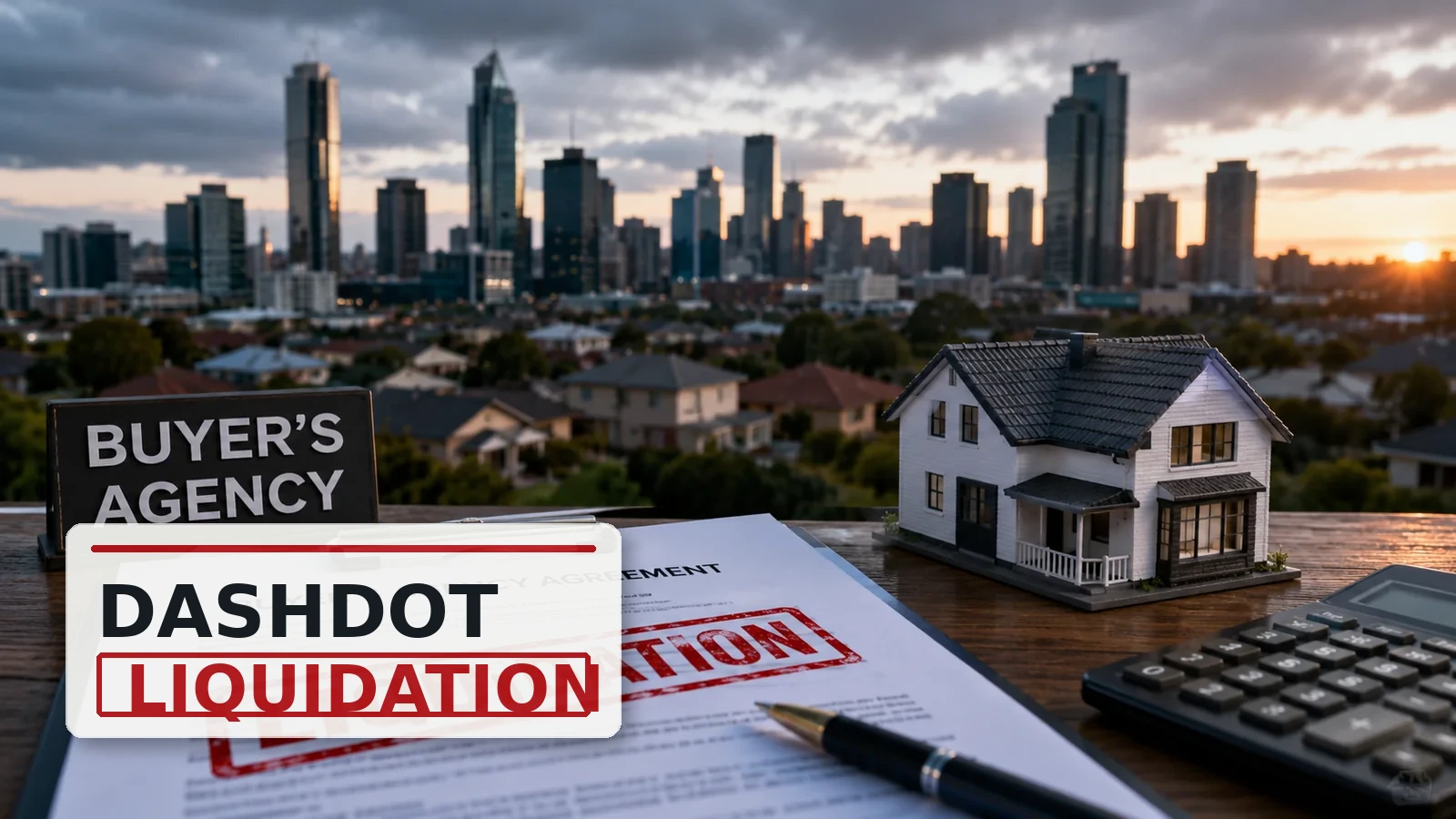
A major buyer’s agency failure has exposed a harder question for investors: how much trust should sit behind an upfront fee?
The collapse of Dashdot has sent a sharp warning through Australia’s property advice market.
Not because every buyer’s agency is weak. Not because investors should suddenly avoid professional help. And not because one company’s failure explains the whole sector.
The bigger issue is trust.
When investors pay thousands of dollars upfront for strategy, sourcing, negotiation or portfolio support, they are not just buying a property service. They are buying confidence that the business will still be there when the deal gets hard, the market turns, or the client needs support after settlement.
That assumption is now being tested.
Dashdot’s co-founder said the business would enter voluntary liquidation on 28 May 2026, according to public reporting. The company had presented itself as a major national property advisory firm, and reports say some clients had paid thousands of dollars in upfront fees before the collapse.
That does not make this a simple blame story.
Businesses fail for different reasons. Property markets change. Credit conditions tighten. Revenue can slow faster than costs. None of that automatically proves wrongdoing.
But for investors, the practical lesson is uncomfortable.
Before choosing a buyer’s agent, the question is no longer just: “Can they help me find a property?”
It is also: “Can this business survive long enough to deliver what I paid for?”
Why this collapse matters beyond one company
Dashdot’s failure matters because it lands at a sensitive point in the property cycle.
Investors are already dealing with higher borrowing costs, weaker serviceability, uncertain tax settings, rental pressure and a market where mistakes are harder to absorb.
Serviceability simply means the lender’s view of whether you can afford the loan after applying buffers, income checks and living expense assumptions.
When serviceability tightens, fewer investors can borrow what they expected. When fewer investors can proceed, property advice firms that rely on new client flow can come under pressure.
That is the part many people miss.
A buyer’s agency can have strong branding, a large social media presence, good testimonials and real past success, but still face cashflow stress if the market shifts against its model.
That is not unique to property. It is how many growth businesses work.
But it matters more when customers pay large upfront retainers.
A client may have paid for a search, strategy or acquisition service, then find the business is no longer able to deliver the original promise. Recovery then becomes an insolvency issue, not a property strategy issue.
That distinction matters.
A new buyer’s agent may be able to help with the next property decision. They cannot automatically recover money from a failed company.
What investors should take from it
The buyer’s agency sector has grown quickly in recent years as more Australians try to build wealth through property, often outside their home city.
That growth made sense. Buying interstate is difficult. Reading a suburb from a spreadsheet is not the same as understanding the street, tenant pool, local agents, flood risk, comparable sales and supply pipeline.
A good buyer’s agent can help reduce those risks, particularly where a purchaser needs someone genuinely acting in their corner. Australian Property Review has previously explained how buyer’s agents advocate for purchasers during search, negotiation and due diligence, which remains true when the service is well structured and transparent.
But what has not changed is the basic rule of investing.
You can outsource work. You cannot outsource judgement.
The investor still needs to understand the strategy, the assumptions, the risks and the contract they are signing.
A buyer’s agent can help with research and execution. They should not become a substitute for thinking.
The catch with upfront fees
Here’s the catch.
Many property advice businesses ask clients to pay before the result is known.
That may be reasonable if the firm is doing genuine strategy, research, sourcing and negotiation work. Professional time has a cost.
But it creates a clear risk.
The client pays early. The value is proven later.
That gap is where investors need stronger protection.
Before paying a buyer’s agent, investors should know:
- what service is being delivered;
- when each part of the service is delivered;
- whether any part of the fee is refundable;
- what happens if finance changes;
- what happens if no suitable property is found;
- what happens if the agency stops trading;
- whether client money is held separately;
- whether referral fees or commissions exist;
- whether the adviser is licensed in the relevant state.
If those answers are vague, the risk is higher.
A polished sales call is not enough. A big founder profile is not enough. A strong podcast or YouTube presence is not enough.
The contract matters.
Quick take: A buyer’s agent can reduce search risk, but they do not remove provider risk. The safer approach is to treat the adviser like part of the investment risk: check the licence, read the contract, ask about refunds, understand conflicts and keep records of every promise made before paying.
Why investors are vulnerable in this market
The current market is not easy for investors.
Higher interest rates have changed the maths. Insurance costs have risen in some locations. Maintenance costs are harder to ignore. Some investors are also worried about policy settings, including tax treatment, rental rules and future supply.
At the same time, many buyers are still attracted to property because rents remain tight in several markets and long-term housing demand has not disappeared.
That combination can push investors into a dangerous middle ground.
They feel pressure to act, but they are less confident making the decision alone.
That is exactly when professional advice can sound most appealing.
The danger is not using advice. The danger is using advice without pressure-testing it.
For example, an investor might be told a market has strong growth potential. That may be true. But the useful question is: what would make that view wrong?
Could new supply soften rents? Could insurance costs reduce cashflow? Could local employment weaken? Could the property be harder to resell? Could a valuation come in lower than expected?
This is where borrowing buffers matter. Australian Property Review has warned that low-deposit property investing can leave buyers exposed when prices soften or repayments rise. The same logic applies to advice risk. When the buffer is thin, the margin for mistakes shrinks.
The lesson is simple.
In a tighter cycle, investors need fewer slogans and more assumptions.
What affected clients should do now
For affected clients, the first step is to separate two problems.
The first problem is recovery.
That means understanding whether any money can be recovered through the liquidation process, consumer protections, legal advice or other formal channels.
The second problem is strategy.
That means deciding whether the original property plan still makes sense.
Do not mix the two.
If you are affected by a buyer’s agency collapse, start by gathering your documents. That includes your contract, invoices, receipts, emails, service agreement, strategy documents, property briefs, payment records and any written promises about refunds or deliverables.
Then check where you were in the process.
Were you still waiting for a strategy session? Had the search started? Were properties already being presented? Had you signed a contract to buy? Were you expecting post-purchase support?
Each stage creates a different problem.
A client who has already bought may need property management, leasing and portfolio support. A client who paid but never received a shortlist may be more focused on recovery. A client who was about to sign a contract may need urgent independent advice before proceeding.
This is where rushing can do damage.
A bad experience can make people either freeze completely or jump too quickly to a new provider.
Neither is ideal.
The better move is to pause and rebuild the plan from the ground up.
Ask:
- Has my borrowing capacity changed?
- Is the original purchase brief still suitable?
- Do I still want the same state, price point and asset type?
- What cashflow buffer do I have after the purchase?
- What evidence would make me comfortable moving forward?
- What went wrong in my previous due diligence process?
That last question is uncomfortable, but useful.
It turns a bad experience into a better process.
How to check a buyer’s agent before signing
The first check is licensing.
A buyer’s agent should be properly licensed or operate under the correct licence in the relevant state or territory. Do not rely only on logos, testimonials or social media profiles. Check the official state register.
The second check is the fee structure.
Ask whether the fee is upfront, staged, success-based or partly refundable. Then ask what happens if the buyer’s agent cannot find a property that fits the agreed brief.
This needs to be written into the agreement.
The third check is conflicts.
Some firms may receive referral income from mortgage brokers, property managers, developers, project marketers, conveyancers or other partners.
Referral income is not automatically wrong. Hidden referral income is the problem.
The fourth check is research quality.
A credible buyer’s agent should be able to explain why a market is being considered and what would make them reject it.
They should be able to talk through recent comparable sales, rental demand, vacancy risk, local supply, insurance costs, employment base, flood or bushfire risk, zoning issues, expected cashflow, downside scenarios and exit strategy.
This matters even more when a buyer is being offered access to properties they may not have found themselves. Australian Property Review has previously examined why off-market property deals can carry hidden risks when access is treated as proof of value.
The rule of thumb is this: if the sales process is stronger than the risk process, keep asking questions.
The second-order effect: trust gets repriced
The buyers agency collapse may have a wider effect on the property advice industry.
Some investors will become more cautious. Some will delay purchases. Some will demand better contracts, clearer refund terms and more evidence before paying.
That is not a bad thing.
The property advice industry has benefited from investor optimism, rising property values and the popularity of personal brands.
But in a tougher market, confidence alone is not enough.
The firms that may benefit from here are not necessarily the loudest. They may be the ones with conservative claims, cleaner contracts, stronger compliance, clearer fee terms and better documentation.
That is less exciting than a high-growth story.
It is also more useful.
Investors do not need hype when their borrowing capacity is tight and the wrong property can damage their next five years.
They need discipline.
What would lower the risk
This issue does not mean buyer’s agents are unsafe as a group.
The risk profile improves when a firm can show proper licensing, clear written service scope, staged payment terms, transparent refund rules, documented research, professional indemnity cover, no hidden commissions, realistic timelines, post-settlement support and a clear complaints process.
It also improves when the investor stays engaged.
That means reading the research, checking comparable sales, asking why alternatives were rejected and getting independent advice where needed.
Property investing is too expensive to run on trust alone.
Bottom line
The buyers agency collapse is a market signal.
It shows that investors face more than property risk. They also face provider risk.
Property risk is buying the wrong asset, in the wrong market, at the wrong price.
Provider risk is paying a business that cannot deliver, cannot refund, or cannot support you when conditions change.
Both risks need due diligence.
The practical lesson is not to avoid buyer’s agents. It is to choose them with the same discipline you would apply to the property itself.
Read the contract. Check the licence. Ask about refunds. Understand conflicts. Keep your own records. Pressure-test the strategy. Know what happens if the service is not delivered.
Start here: before paying any buyer’s agent, write down the exact service, the fee at risk, the refund terms and the evidence you need before moving ahead.
If you want the weekly signal, subscribe to the free Australian Property Review newsletter